



- About UPF-BSM
- Programs
- Faculty and research
- Companies and Organizations
- News & Events


Alumni gathering at UPF-BSM to address the communication challenges of the healthcare sector at the Alumni Industry Forum (Pharma & MedTech)
9 Abril - 2026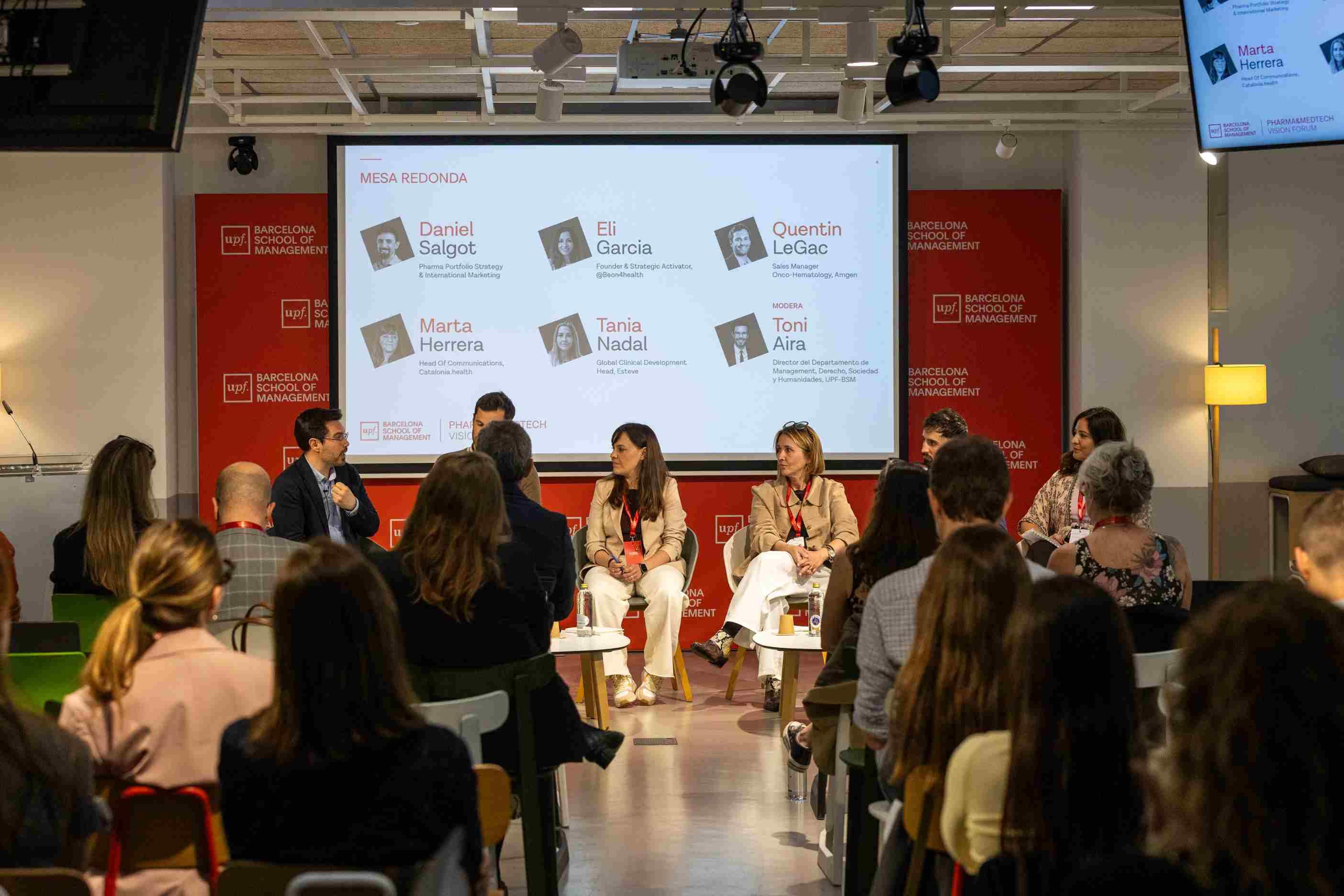
Today, the Alumni Industry Forum on the Pharma & MedTech sector took place at the UPF Barcelona School of Management (UPF-BSM), as part of an alumni gathering organized by the school. The forum addressed one of the major challenges facing the healthcare sector: how to build trust in a context marked by information overload, technological disruption, and the growing complexity of the health ecosystem.
The session began with an institutional welcome by José M. Martínez-Sierra, Director General of UPF-BSM, who emphasized the institution’s commitment to social impact: “Healthcare and education are two of the fundamental pillars of the welfare state.” In this regard, he highlighted the role of education and the alumni community as drivers of transformation: “We try to give back the support and trust you have given us; we want you to feel that the doors of your home are more open than ever.”
This was followed by a panel discussion moderated by Toni Aira, professor and Director of the Master’s in Political and Institutional Communication at UPF-BSM. The panel featured alumni participants: Daniel Salgot, Pharma Portfolio Strategy & International Marketing; Eli Garcia, Founder & Strategic Activator at Beon4health; Quentin Le Gac, Sales Manager in Onco-hematology at Amgen; Marta Herrera, Head of Communication at Catalonia Health; and Tania Nadal, Global Clinical Development Head at Esteve.
One of the main topics discussed was the difficulty of building trust in an environment saturated with information. “We have overwhelming amounts of information—we are constantly bombarded—which makes it difficult to filter and digest it,” commented Marta Herrera.
In this context, responsibility does not lie solely with those who communicate, but also with those who consume information. “The need for reliable, high-quality sources becomes critical at a time when misinformation can erode scientific credibility,” Herrera added.
Scientific Evidence vs. Narrative
Is scientific evidence more important than the way it is communicated? For the experts, the answer is not either/or. Daniel Salgot emphasized that “it is very important for the foundation to be evidence-based, as credibility rests on it.”
However, evidence alone is not enough. Tania Nadal pointed out that “we often forget the value of that evidence; as a community, we need to work more on communicating the value we provide.”
Quentin Le Gac added: “We need to translate value without oversimplifying.”
Scientists and Decision-Making
Another key topic of discussion was the role of scientists in business decision-making. Rather than framing it as a dichotomy, the panelists advocated for an integrated approach.
Tania Nadal argued for more open models: “It is important to have many more stakeholders at the table, but decisions must be clearly based on defined criteria.”
In the same vein, Daniel Salgot added: “It is impossible to leave scientists out of decision-making, but we need to clearly define their role.” The ultimate goal: achieving business sustainability aligned with health impact.
AI and the Irreplaceable Role of People
The panel also explored how the emergence of technologies such as artificial intelligence is reshaping the sector. On this point, the speakers agreed that the human factor remains central.
Tania Nadal stated it clearly: “There must always be a person; the human component cannot be missing.”
Rather than replacing humans, technology should complement them. As Eli García noted: “There will be tasks that we will delegate to machines, so we need to understand which skills we must develop to manage those machines.”
In this new landscape, education becomes an urgent challenge. Quentin Le Gac pointed out that “this technology has arrived very quickly, and what we may be lacking now is training.”
The Pharma & MedTech Vision Forum conveyed a clear message: the future of the sector depends not only on technological innovation or scientific rigor, but on the ability to integrate both with effective communication and a deeply human-centered vision.